


Burnout can make work feel heavier, relationships thinner, and rest strangely ineffective. For Fayetteville, Arkansas, residents looking for therapy for burnout, the goal is not simply to “push through,” but to understand what is draining you, rebuild coping capacity, and make practical changes that protect your mental health support system over time.
The most useful care that Twila Owens, owner of Clarity Counseling Services, recommends to her therapy clients combines evidence-informed therapy techniques, daily stress management, and realistic workplace boundaries.
What does burnout therapy actually treat?
Therapy for burnout treats the patterns that keep chronic work stress going: emotional exhaustion, cynicism or detachment, reduced confidence, poor recovery habits, and the belief that you must handle everything alone.
The World Health Organization describes burnout as an occupational phenomenon caused by chronic workplace stress that has not been successfully managed, marked by exhaustion, mental distance or negativity toward work, and reduced professional effectiveness. (who.int)
That distinction matters. Burnout is not laziness, weakness, or ordinary tiredness after a busy week. It is a work-related strain pattern that can affect sleep, mood, concentration, physical tension, motivation, and how you relate to coworkers, clients, patients, students, or customers.
In therapy, you and your provider look at both the internal habits that keep you overloaded and the external pressures that may need boundaries, negotiation, or structural change.
Burnout recovery starts with naming the real pattern
Many people in Fayetteville wait to seek counseling until they feel completely depleted. That is understandable, especially for teachers, healthcare workers, university staff, business owners, caregivers, service workers, and remote professionals who are used to being dependable.
But burnout recovery often begins earlier, when you notice the pattern repeating: Sunday dread, irritability, brain fog, sleep that does not restore you, or a growing sense that your work no longer matters.
A therapist like Twila can help you separate the parts of burnout that come from workload, workplace culture, perfectionism, people-pleasing, unresolved stress, trauma history, or lack of recovery time. That map is important because different causes require different coping strategies.
If the main driver is an impossible workload, meditation alone will not solve it. If the main driver is harsh self-criticism, a better calendar may help but will not address the inner pressure that keeps you overfunctioning.
Therapy approaches that can help with burnout in Fayetteville
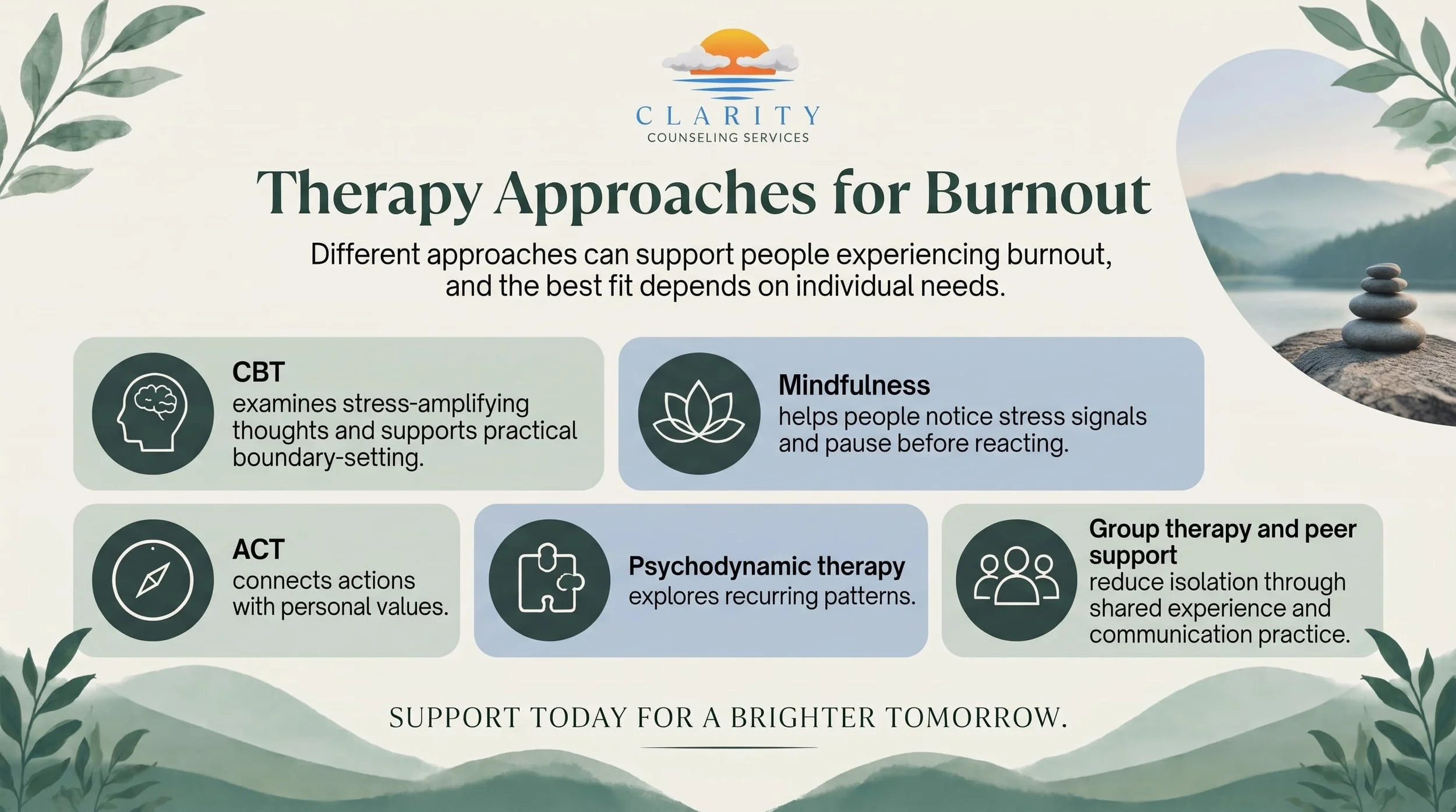
No single method is perfect for every person, but several approaches are commonly used for burnout, work-related stress, and emotional exhaustion. The best fit depends on your symptoms, goals, schedule, budget, and whether you are also experiencing anxiety, depression, grief, trauma symptoms, or relationship strain.
Cognitive behavioral therapy builds practical change
Cognitive behavioral therapy, often called CBT, is one of the most common therapy techniques used for work stress and burnout-related exhaustion.
A scoping review of psychological treatments for persistent non-traumatic stress found that CBT was the most frequently reported treatment, while noting that burnout care still benefits from individualized, process-based planning rather than a one-size-fits-all protocol. (pubmed.ncbi.nlm.nih.gov)
In practice, CBT helps you identify thoughts and behaviors that intensify stress. A Fayetteville resident who thinks, “If I set a boundary, everyone will think I’m unreliable,” may keep accepting extra tasks until resentment and fatigue build.
CBT would not simply replace that thought with forced positivity; it would test the belief, examine evidence, build a more balanced response, and pair it with a specific behavior such as delaying nonurgent replies, clarifying priorities, or asking a supervisor which task should come first.
Useful CBT tools for burnout include:
Thought records: Write down the stressful situation, automatic thought, emotional reaction, and a more balanced alternative.
Behavioral experiments: Try one small boundary and observe what actually happens.
Activity scheduling: Rebuild restorative routines instead of waiting to “feel motivated.”
Problem-solving plans: Break overwhelming work issues into controllable next actions.
Relapse prevention: Identify early warning signs before burnout returns.
Mindfulness-based therapy improves stress awareness
Mindfulness-based approaches can help when your nervous system stays on alert even after work ends.
A systematic review of mindfulness-based stress reduction and related programs in employees found the strongest outcomes included decreases in emotional exhaustion, stress, psychological distress, depression, anxiety, and occupational stress, while also noting limits in study quality. (pmc.ncbi.nlm.nih.gov)
Mindfulness in Fayetteville therapy is not about pretending stress is fine. It is the skill of noticing stress signals earlier, pausing before reacting, and returning attention to the present instead of spiraling into tomorrow’s inbox, next week’s meeting, or last month’s mistake.
Sessions may include breathing practices, body scans, grounding skills, gentle movement, or short exercises you can use in a parked car before walking into work.
For many burned-out professionals, mindfulness works best when it is paired with action. Awareness helps you notice the clenched jaw, shallow breath, or dread. Counseling then helps you decide what that signal is asking for: rest, a boundary, a difficult conversation, medical evaluation, or a change in expectations.
Acceptance and commitment therapy reconnects you with values
Acceptance and commitment therapy, or ACT, can be useful when burnout has narrowed your life to obligation and survival.
ACT focuses on psychological flexibility: making room for difficult feelings while choosing actions that align with your values. Instead of asking, “How do I eliminate all stress?” ACT asks, “What kind of person do I want to be in the presence of stress, and what needs to change so I can live that way?”
This can be especially helpful for people in service-oriented roles.
A nurse, counselor, teacher, nonprofit worker, or parent may genuinely value care and responsibility, yet feel trapped by endless giving. ACT helps separate values from overextension. You may still value compassion, but that does not require answering messages at midnight or sacrificing every personal need.
Psychodynamic therapy explores deeper burnout patterns
Some burnout is tied to long-standing emotional patterns: needing approval, fearing conflict, proving worth through achievement, or feeling responsible for everyone else’s comfort.
Psychodynamic therapy can help explore where those patterns came from and how they show up at work. This approach may be slower than short-term skills-based care, but it can be meaningful when burnout keeps returning despite surface-level changes.
For example, if you repeatedly take on impossible workloads because saying “no” feels dangerous, the issue may not be time management alone. Therapy can help you understand the emotional meaning of limits, practice tolerating discomfort, and build a more secure sense of self that is not dependent on constant productivity.
Group therapy and peer support reduce isolation
Burnout often convinces people they are the only one struggling. Group therapy or structured peer support can challenge that isolation, especially for people in high-demand professions. Hearing others name similar exhaustion, guilt, resentment, or numbness can reduce shame and make coping strategies feel more realistic.
Group settings can also help you practice communication skills. You might rehearse a boundary, receive feedback, or learn how others handle workload pressure. For some Fayetteville residents, a mix of individual therapy and group support offers both privacy and connection.
How do you know it is burnout and not depression or anxiety?
Burnout is specifically tied to chronic work stress, while depression and anxiety can extend across many areas of life and may require different or additional treatment. The National Academies notes that WHO distinguishes burnout as employment-related rather than an individual mental health diagnosis, and that it should be considered distinct from mood disorders. (ncbi.nlm.nih.gov)
Still, symptoms can overlap. Burnout can bring sleep problems, low motivation, irritability, hopelessness about work, and physical tension.
Depression may include persistent sadness, loss of interest in most activities, appetite changes, feelings of worthlessness, and thoughts of death or self-harm. Anxiety may include excessive worry, panic symptoms, avoidance, restlessness, or a constant sense that something will go wrong.
A Fayetteville mental health counselor like Twila Owens can help you sort through these differences without forcing you into a label too quickly. If symptoms are severe, long-lasting, or affecting safety, a therapist may also recommend coordination with a physician, psychiatrist, or other healthcare professional.
If you are in immediate crisis, in the U.S. you can call or text 988 or use chat through the 988 Suicide & Crisis Lifeline for immediate support. (988lifeline.org)
A practical burnout recovery plan for Fayetteville residents
Therapy is most effective when insights become repeatable daily practices. You do not have to overhaul your entire life at once. In fact, burnout recovery usually works better when you start with small, consistent changes that rebuild trust in your own limits.
Use this three-part framework as a starting point:
1). Recognize the pattern
Track when emotional exhaustion spikes.
Notice which tasks, relationships, or meetings drain you most.
Write down physical cues such as headaches, insomnia, stomach tension, or muscle tightness.
Identify thoughts that intensify pressure, such as “I can’t disappoint anyone” or “Rest has to wait.”
2). Reverse the immediate drain
Protect one nonnegotiable recovery block each week.
Reduce unnecessary commitments where possible.
Ask for clarification when priorities compete.
Practice a short decompression ritual after work, such as a walk, shower, breathing exercise, or phone-free transition time.
3). Build resilience against recurrence
Use therapy to strengthen boundaries and self-advocacy.
Create a relapse plan for busy seasons.
Reconnect with non-work identity: friendships, hobbies, faith, nature, movement, creativity, or community.
Address workplace factors instead of treating burnout as a purely personal failure.
In Fayetteville, your recovery plan might include local routines that are realistic for your life: stepping outside between shifts, using a lunch break away from screens, walking after work, scheduling therapy before the week gets crowded, or setting boundaries around evening email.
The details matter less than consistency. Your nervous system learns safety through repeated signals that work is not allowed to consume every part of your day.
Matching therapy to your situation

“I can’t stop overthinking work.”
Therapy Focus: CBT, ACT, mindfulness
Benefit: Reduce rumination and build healthier responses
“I know I need boundaries, but I feel guilty.”
Therapy Focus: CBT, psychodynamic therapy, assertiveness training
Benefit: Understand guilt and practice direct communication
“My body stays tense even when I’m off.”
Therapy Focus: Mindfulness, somatic skills, relaxation training
Benefit: Calm stress physiology and improve recovery routines
“I feel detached from clients, students, or coworkers.”
Therapy Focus: Individual or group therapy
Benefit: Process cynicism, compassion fatigue, and isolation
“My workplace expectations are unsustainable.”
Therapy Focus: Therapy plus workplace problem-solving
Benefit: Prepare for advocacy, role clarification, or career decisions
Finding burnout support in Fayetteville, Arkansas
When looking for burnout counseling in Fayetteville, consider both clinical fit and practical fit. Arkansas regulates the titles and practice of licensed counselors and marriage and family therapists, and the Arkansas Board of Examiners in Counseling provides license verification resources for the public. (healthy.arkansas.gov)
As you contact providers, ask direct questions. You are allowed to be selective. Burnout can make decision-making hard, so keep your criteria simple:
Does the therapist work with burnout, workplace stress, anxiety, depression, perfectionism, or life transitions?
Do they offer in-person sessions in Fayetteville, telehealth, or both?
What therapy techniques do they commonly use?
How do they approach stress management and burnout recovery planning?
Do they help with boundaries, communication, and workplace decision-making?
Are they licensed to provide care to clients located in Arkansas?
Do scheduling, cost, insurance, and availability make ongoing care realistic?
If you are a student, employee, caregiver, or shift worker, logistics matter. The “best” therapy on paper may not help if appointments are impossible to attend. Choose support that you can actually use consistently.
When should you seek professional help?
You should consider professional help when burnout symptoms persist despite rest, interfere with work or relationships, affect sleep or physical health, or make you feel hopeless, numb, trapped, or unlike yourself. You do not need to wait until you are in crisis to ask for mental health support.
Therapy becomes especially important if you are using alcohol, food, shopping, isolation, or overwork to cope; if you are having panic symptoms; if you dread work every day; or if loved ones are telling you they are worried.
It is also worth seeking help if you have tried self-help strategies but keep returning to the same cycle. Burnout recovery is not always linear, and having a trained person help you adjust the plan can prevent discouragement from turning into resignation.
If thoughts of self-harm or suicide appear, treat that as urgent. Call or text 988, use crisis chat, contact a trusted person, or go to the nearest emergency department. Burnout is common, but you should not have to carry dangerous thoughts alone. (988lifeline.org)
The takeaway for Fayetteville residents
Burnout recovery is not about becoming more productive so you can tolerate an unhealthy pace forever. It is about restoring energy, rebuilding choice, and creating a life where work has boundaries. For Fayetteville residents seeking therapy for burnout, effective care often blends CBT, mindfulness, values-based work, deeper emotional exploration, and practical coping strategies that fit real schedules and real pressures.
Start small: name the pattern, ask for support, and choose one recovery habit you can repeat this week. The sooner you address emotional exhaustion with the right help, the more room you create for clarity, connection, and sustainable work.
If you’re struggling with burnout in Fayetteville and need help knowing how to recover, Twila Owens is glad to help. She’s a counselor in West Fork with over 20 years of experience and has helped many clients move from burnout to wholeness. Feel free to reach out online by filling out a contact form, and she’ll get back to you as soon as possible.